
About this skill
Anatomy is an open-source skill by Ryan. Instead of boxes and arrows, your agent invents a physical object whose working is the idea: a pin-tumbler lock for a cache key, a plotter for a shared GPU context. It builds that object from dozens of small solid parts, frames it in a card with a live readout driven by one true model, and checks its own work at 4x zoom. A figure ships as one HTML page, a lone SVG or React components. It can add WebGL fire, water and light in the same camera, turn parts in 3D (beta), and print to an A4 PDF.
You say
Explain how a token bucket rate limiter works as an interactive isometric figure for my blog post. Capacity is 10 tokens, refill is 2 per second. One HTML file, light theme.
How it works
- Tell your agent the idea and its real numbers. It sizes the job first: a Figure, a Hero of about 2 to 4 hours, or an Epic it won't start without your choice.
- It invents a machine whose working is the idea, writes a parts list of 40 or more, and puts the true behaviour in one small model.
- It builds the parts with the kit and paints them back to front in a card with a live readout, as one HTML page, an SVG or React components.
- It proves the geometry with an audit and a line check, then reads screenshots and 4x close-ups in both themes and fixes what they show.
Getting a good result
- Name the idea, not the drawing, and give real sizes, rates and thresholds. Inventing the object is most of what the skill does.
- Say where the figure will live and in which theme, because a page, a lone SVG and React components build differently.
- Build the closest example first with node examples/<name>/build.mjs, since the ZIP holds its source and not its page.
What you get
- The Anatomy skill at a pinned commit, with its MIT license
- A drawing kit in plain Node modules, with React components
- The source of nine example figures to copy from, such as a ripple tank and an arcade cabinet
- A geometry audit and a line check for parts and lines that fail to meet
- Headless Chrome scripts for screenshots, close-ups and A4 PDFs
- A script that submits a figure to the author's public gallery, only if you ask
Good fit
- Explaining an algorithm or system in a docs page or blog post
- A hero illustration for a technical landing page
- Interactive explainers built on real numbers
Not for
- Charts and data plots: it has no axes or series
- People, characters or exact maps
- A quick image: even a small figure is a long agent session
How to install it
- Download the ZIP and unzip it.
- Inside the ZIP's top folder, move the anatomy folder that holds SKILL.md into your agent's skills folder, such as ~/.claude/skills/, and keep ATTRIBUTION.md with it. There is nothing to install.
- Start a new session and ask for what you want to make.
Needs: An agent that reads skills and can look at images, Node.js 20.10 or newer, Chrome or Chromium, for its checks, React 18 or newer, only for React output, The GitHub CLI, only to publish to the author's gallery.
FAQ
Is it really free?
Yes. Create a free AdAnt account to download the ZIP. There is no card and no trial timer, and the original is public on GitHub, linked on this page.
Does it need an API key or the internet?
No key, and nothing to npm install: the kit and scripts use only Node's built-in modules. The kit, the examples and the 16 pages they build hold no network calls or outside addresses. Only scripts/publish.mjs reaches out, to GitHub through gh and git, and only when you ask it to. The Chrome checks do not switch off Chrome's own background traffic, and capture.mjs and drive.mjs will open a web address if you give them one.
What does it run on my machine?
Node, for the builds and checks. capture.mjs, drive.mjs, lines.mjs, turn-check.mjs and print.mjs also start headless Chrome, Chromium or Edge, from the usual install paths, Playwright's cache or CHROME_PATH, with a temporary profile and a debugging port on 127.0.0.1. They pass --allow-file-access-from-files, so a page opened from disk can read your other local files, and nothing stops that page from reaching the network. On Linux they also pass --no-sandbox, which turns off Chrome's own sandbox. Point them only at your own figures, never at a page someone sent you. drive.mjs runs any JavaScript you give it in the page, and print.mjs, turn-check.mjs and turn-bench.mjs import the file you name as code.
Will it start on its own, and how long does it take?
It can. Its description asks agents to use it for any explanatory diagram or figure, even if you never say isometric. A Figure, its smallest size, then builds without asking and without quoting a time, and the skill budgets up to an hour of your agent's usage for it. A Hero, about 2 to 4 hours, says so and starts unless you asked for something quick. Only an Epic waits for your choice. If usage matters, name the size you want, or keep the skill out of projects where you want quick diagrams.
What happens if I publish a figure to the gallery?
Nothing is sent unless you ask. The script pushes only with --submit, and it asks first unless your agent passes --yes, which the skill tells it to do only after showing you the plan and getting your yes. So your answer to your agent is the real gate. Then publish.mjs copies the figure's source into a clone of wheresryan22/anatomy-community, which means every .mjs, .js, .css, .json, .md, .txt and .svg file in its folder and any .html that is not a built page, so keep private notes out of that folder. It forks the repo if you can't push to it, runs gh auth setup-git, which changes your git credential settings, force-pushes a figure branch and opens a public pull request, under MIT unless you pick CC-BY-4.0. It sends the request that made the figure, your GitHub name, and the agent and model. The skill says to trim that request to 600 characters, but the script does not enforce it and its plan does not show it, so ask to see the text first. In Claude Code it also reads this session's log in ~/.claude/projects, and only the minutes and tokens it works out leave your machine; ask for --no-session to skip the log.
Has AdAnt read all of it?
Most of it, and AI agents did this review for us, not a person. They read SKILL.md, all ten references and every script in the ZIP. The kit and the examples were only scanned, for network calls, storage, processes, environment variables and link parameters, and the scan found none. They also rebuilt every framework-free example and ran the capture, line and print scripts, but not the audits, turn-check.mjs or publish.mjs. It is someone else's code, so read it before you trust it.
Is anything left out of the ZIP?
Yes, which takes it from 26 MB to under 2 MB: the 16 built example pages, the 9 printed PDFs, the project's regression tests and test prompts, its README and other project documents, and .github with the README's images. The skill needs none of them. Example sources are all there, because SKILL.md tells your agent to open them, and each framework-free example's own scripts write its pages next to them, inside the skill's folder. We rebuilt all 16: ten match upstream byte for byte, and six differ only by the PDF link a card shows once its poster PDF exists. Every file kept is unchanged.
Do its examples show anyone's logo or product?
Two do. The desk computer draws Anthropic's mark on its screen, names it in its caption and types "hello, claude", in a case that recalls a 1984 all-in-one, though its code names no maker. The Raptor example models SpaceX's Raptor 2 and names it on a label plate and in its caption. As far as we know neither company is involved, and the MIT license does not cover their names or marks, so don't reuse those in your own figure. The arcade cabinet carries the Anatomy name, its screen runs a rows-of-invaders game drawn in its own source, and its self-test names the Z80 chip. SKILL.md also lists "Linear-style" among the words that wake it. Our clip here shows the ripple tank, which has no marks.
Anything else to know in this version?
SKILL.md says eight examples ship, but there are nine, with a push button. Its reference list also says nothing is pushed for you, while publish.mjs does push with --submit, as described above. A few references name files that were never in the repo, such as 3d/engine/plants.mjs and mount.ts; they are prose and break nothing. Run print.mjs only with your own options, since it deletes an existing PDF at its output path without checking where that is. Ctrl-C during a check can leave Chrome and its temporary profile behind. The 3D mode is beta, and its full audit takes 15 to 20 minutes for 30 parts.
Related skills
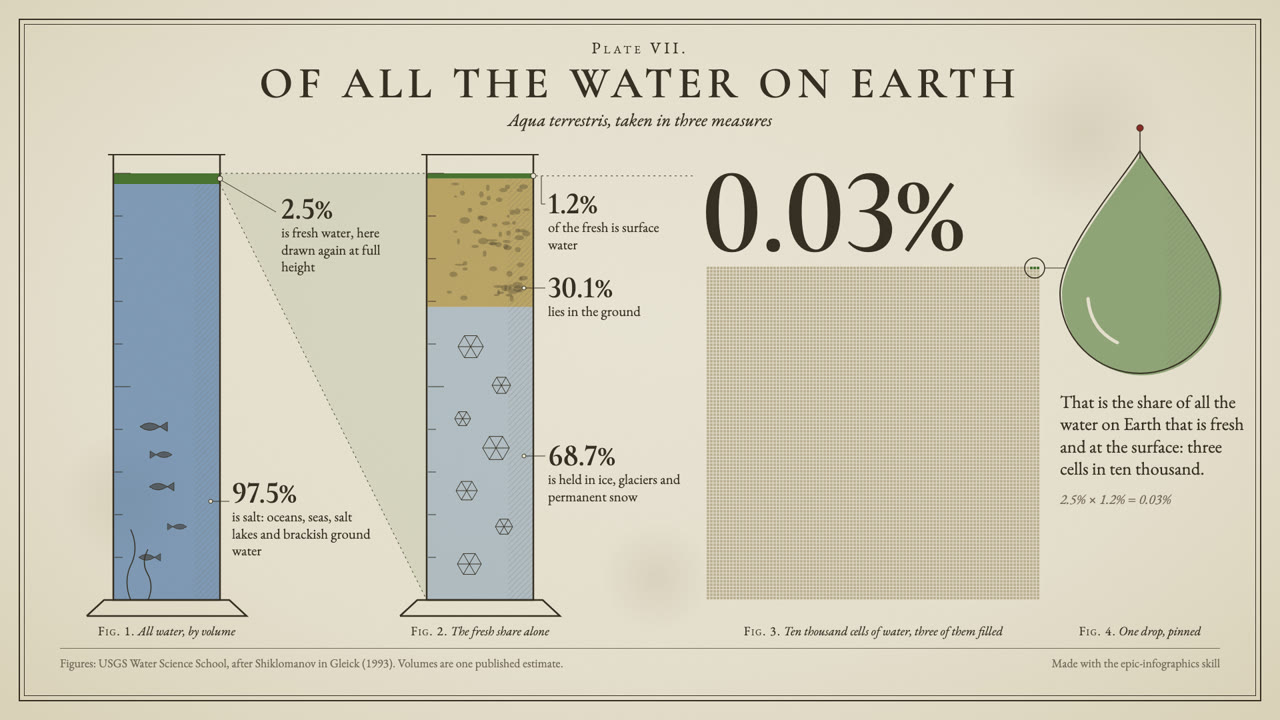
Epic Infographics: Data Graphics Built as Scenes
Have your agent design an infographic as one HTML page, check its layout by machine, render a PNG, and animate it to video if you want.
Illo: Editorial Illustrations With a Recurring Mascot
Have your agent turn one idea or an article into original print-style illustrations where a recurring mascot acts the idea out.
HyperFrames: HTML to Video
Have Claude write launch films, explainers and title cards as HTML, then render them to MP4.