
AI Social Media Marketing: Can AI Agents Actually Run Your Social Media?
Yes, AI agents can automate a meaningful share of the social media marketing workflow: research, planning, creation, publishing and measurement. But the strongest systems still need humans for direction, taste, brand judgment, and important decisions. The opportunity is not to remove people from marketing. It is to change where human attention is spent.

A practical guide to AI social media agents, continuous marketing workflows, human oversight, and what changes when AI stops waiting for the next prompt.
AI can create content. But can it actually do marketing?
AI can already write captions, generate images, make short videos, and brainstorm dozens of ideas in seconds. The harder question is whether AI can help run the continuous work behind social media marketing: researching what is changing, deciding what is worth testing, creating content, publishing consistently, learning from results, and adapting without requiring a human to manually push every step forward.
Yes, AI agents can automate a meaningful share of the social media marketing workflow. But the strongest systems still need humans for direction, taste, brand judgment, and important decisions. The opportunity is not to remove people from marketing. It is to change where human attention is spent.
Most AI marketing products still behave like tools: you ask, they generate, and the workflow stops. Social media does not stop. Trends move, audiences get bored, competitors react, and yesterday's winning format becomes today's background noise.
What is an AI social media agent?
An AI social media agent can pursue a marketing goal across multiple connected steps rather than completing one generation task. It can use context about a product and audience, perform research, decide what action should happen next, create or coordinate work, and continue within boundaries set by the user.
A content generator follows human asks → AI creates → stops. An agentic system is closer to human sets direction → AI researches → plans → creates → coordinates → measures → continues.
The key difference is not better generation. It is continuity. This is the model we have been exploring with AdAnt: a proactive AI social media marketing team rather than another content box waiting for a prompt.
How does an AI social media marketing system work?
A useful system is a learning loop rather than a content factory. Research identifies relevant trends, competitors, formats, and conversations. Strategy turns that information into hypotheses. Creation turns hypotheses into content. Human review adds judgment where it matters. Publishing puts the work in front of a real audience. Measurement captures signals. Learning feeds those signals into the next round.
Research → Strategy → Create → Review → Publish → Measure → Learn → repeat
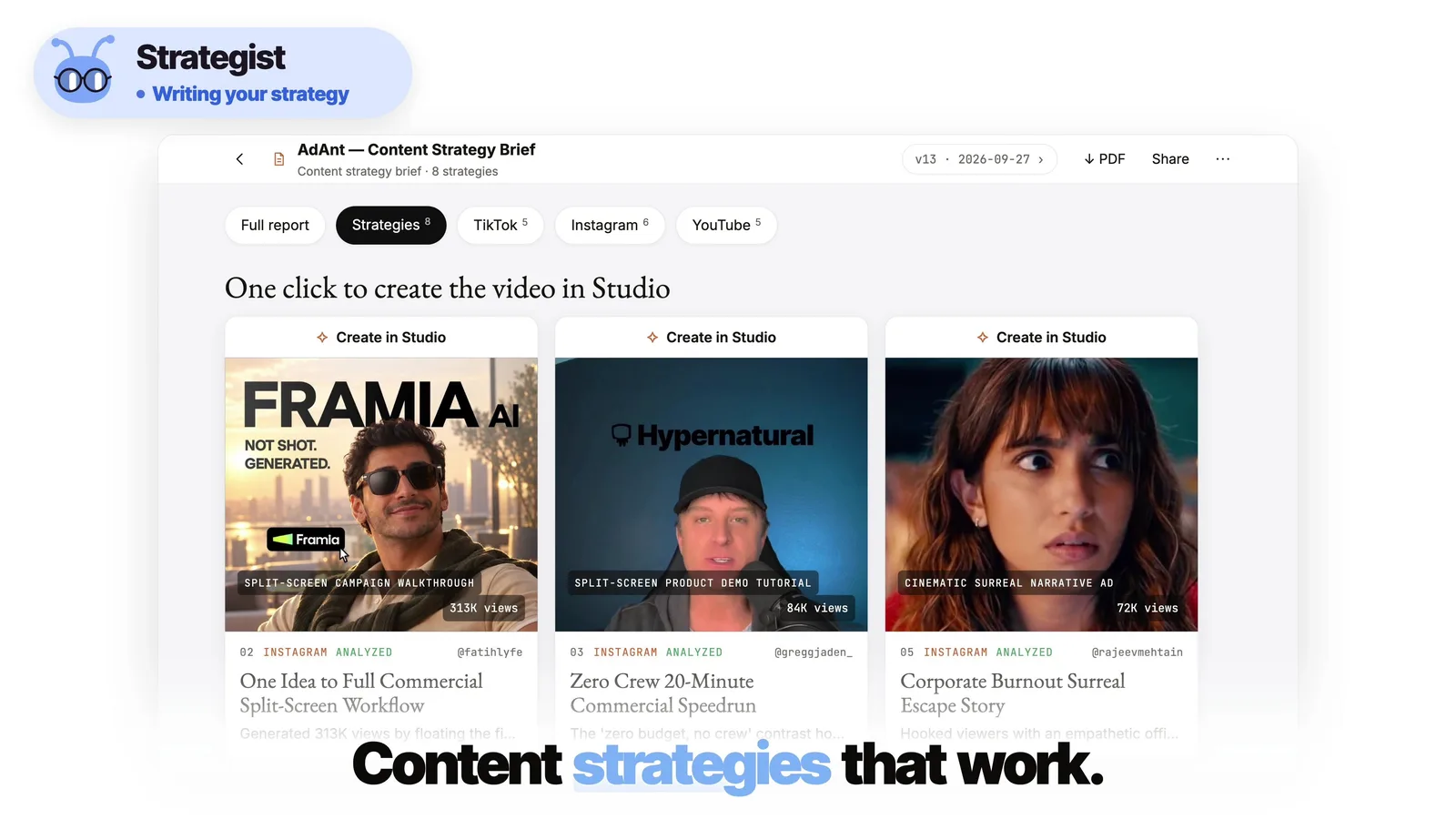
In AdAnt, those responsibilities are represented by collaborating agents: the Strategist researches the market and develops directions to test; the Creator turns strategies into ready-to-post content; the Analyst listens to conversations and emerging signals; and the Manager coordinates tasks, calendars, scheduling, and publishing.
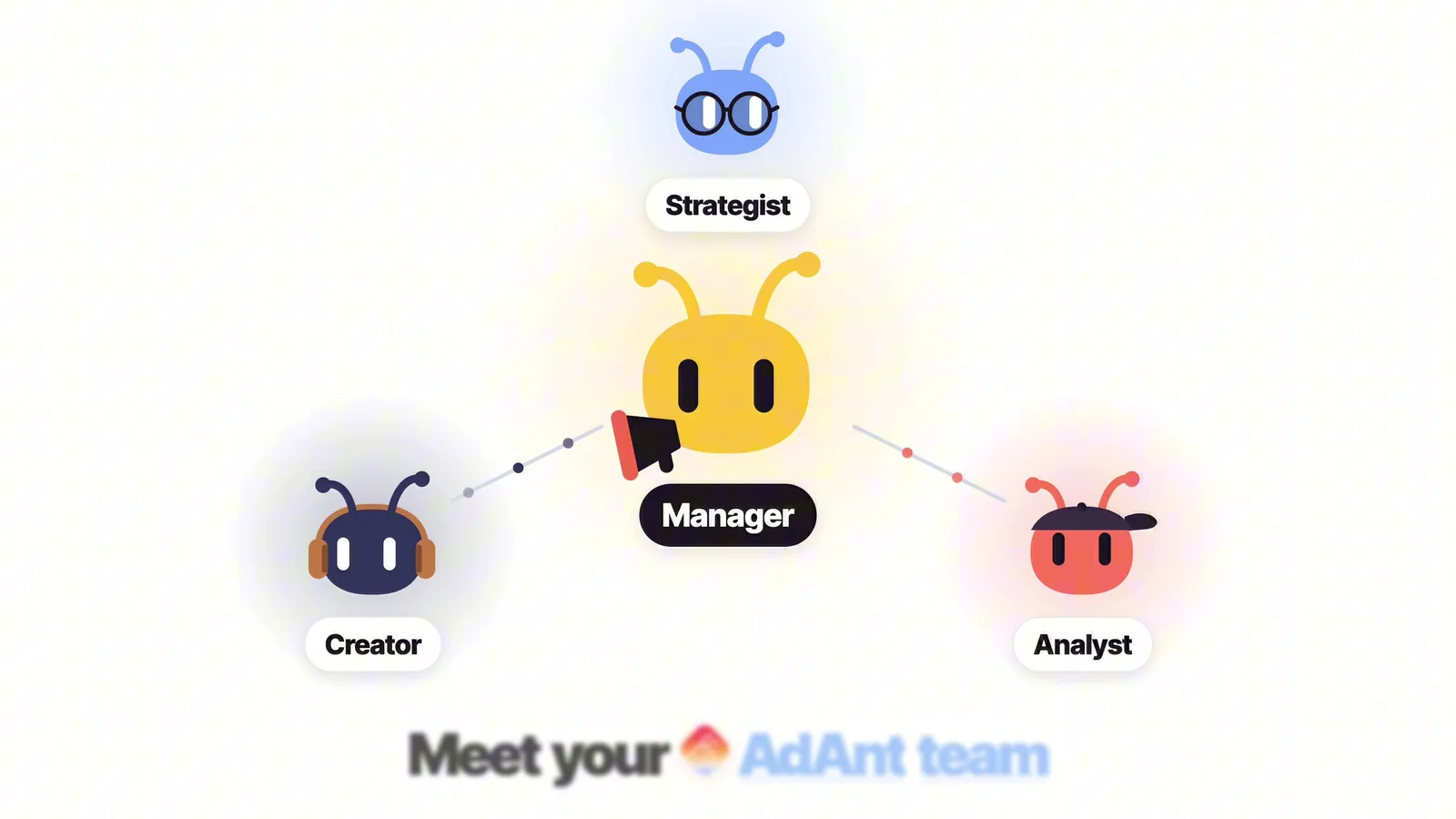
The important part is not the names or number of agents. It is whether context moves between them. If research finds a new format, creation should know why it matters. If a post performs unexpectedly well, that should influence future strategy. If a human rejects an idea because it feels off-brand, that feedback should become useful context.
Why multiple agents instead of one AI assistant?
Marketing combines different kinds of work. Research requires scanning and synthesis. Strategy requires prioritization. Creation requires translating an idea into something people will watch. Listening requires monitoring external conversations. Coordination requires keeping the system moving over time.
The value of multiple agents comes from specialization and handoffs, not from giving AI characters different names. A Strategist may identify a trending format while the Creator concludes that a literal execution would feel forced for the brand. That disagreement can be productive: adapt the idea, propose an alternative, or escalate an important judgment call to the human.
Autonomy does not mean removing human judgment. It means reserving human judgment for the moments where it adds the most value.
Where should humans stay in the loop?
Humans should own direction, taste, brand boundaries, sensitive decisions, and major course corrections. AI agents can take on much of the research, execution, coordination, monitoring, and repetitive follow-through.
A practical model is: human sets direction → agents execute → human reviews and gives feedback → agents adapt → routine work becomes increasingly automated. Early on, the human may review frequently. Over time, repeated feedback can establish clearer boundaries.
Humans stay in the loop, but they do not have to drive the loop.
Why should research come before creation?
The falling cost of generation makes research more important, not less. If AI can create a hundred videos cheaply, the temptation is to generate a hundred random ideas and call that experimentation. Cheap randomness is still randomness.
A better workflow narrows the search space first: what is gaining attention in this category, which formats are emerging, what competitors repeat, what hooks and structures appear in successful content, and which patterns are relevant to this product and audience.
Research cannot predict the winner. The audience still supplies reality. Research reduces blind experimentation; testing supplies the next layer of information.
What should AI automate, and what should humans own?
AI is especially useful for continuous, repetitive work: scanning platforms, researching competitors, monitoring conversations, generating variations, producing content, scheduling, publishing, and summarizing performance. Humans remain especially valuable for taste, positioning, brand identity, cultural nuance, relationships, and deciding what should never be posted.
AI can increase the speed of the marketing loop. Humans still decide where the loop should go.
Does this actually work?
We tested this approach on a brand-new Instagram account with no existing audience and no paid distribution. Before the experiment, I had never made a video and had barely posted on social media.
In the first two weeks, 30 posts generated 7.8M organic views and grew the account to 6,000+ followers. We kept going. After one month, the account had 49.9M views and 10.5K followers.
Those numbers are evidence from one account, not a guarantee of similar results. The companion case study explains what happened, what we think drove the learning loop, and what the experiment cannot prove.
What do marketers actually worry about?
When we shared the early experiment on LinkedIn, the post generated 165,864 impressions and reached 99,197 members; 98% of that reach was out-of-network. It produced 2,013 social engagements, including 211 comments.
The discussion shifted the questions from Can AI generate content? to Can I control it? Can it understand my brand? Can multiple agents coordinate? Can it connect attention to business outcomes? We treated the comment section as customer research, and the third article in this series examines those concerns.
Frequently asked questions
What is an AI social media agent?
A system that can carry out multiple connected marketing steps toward a goal rather than stopping after one generated asset.
Can AI manage social media for a small business?
It can automate a meaningful share of research, ideation, creation, scheduling, publishing, and analysis while humans retain responsibility for direction and judgment.
What is the difference between an AI agent and an AI content generator?
A generator produces an asset. An agent can use context, decide what comes next, coordinate steps, and continue working toward a broader goal.
Can AI maintain brand voice?
It can help, but consistency requires persistent context, examples, boundaries, and human feedback, not a single brand prompt.
Will AI replace social media managers or agencies?
The more immediate change is leverage: more execution and coordination can be automated while human value shifts toward taste, positioning, relationships, and judgment.