
We Analyzed 211 Comments About AI Marketing. Here's What Marketers Actually Care About.
We read the 211 comments on a LinkedIn post about our AI social media experiment. Marketers rarely asked whether AI can make a video. They asked about brand voice, human oversight, agent coordination, content quality, revenue, and account safety. The barrier to AI marketing is moving from generation to control, learning, and trust.

A LinkedIn post about an AI social media experiment generated 165,864 impressions and sparked 211 comments. The questions reveal where the real barriers to AI marketing are moving.
Why did we analyze the comments?
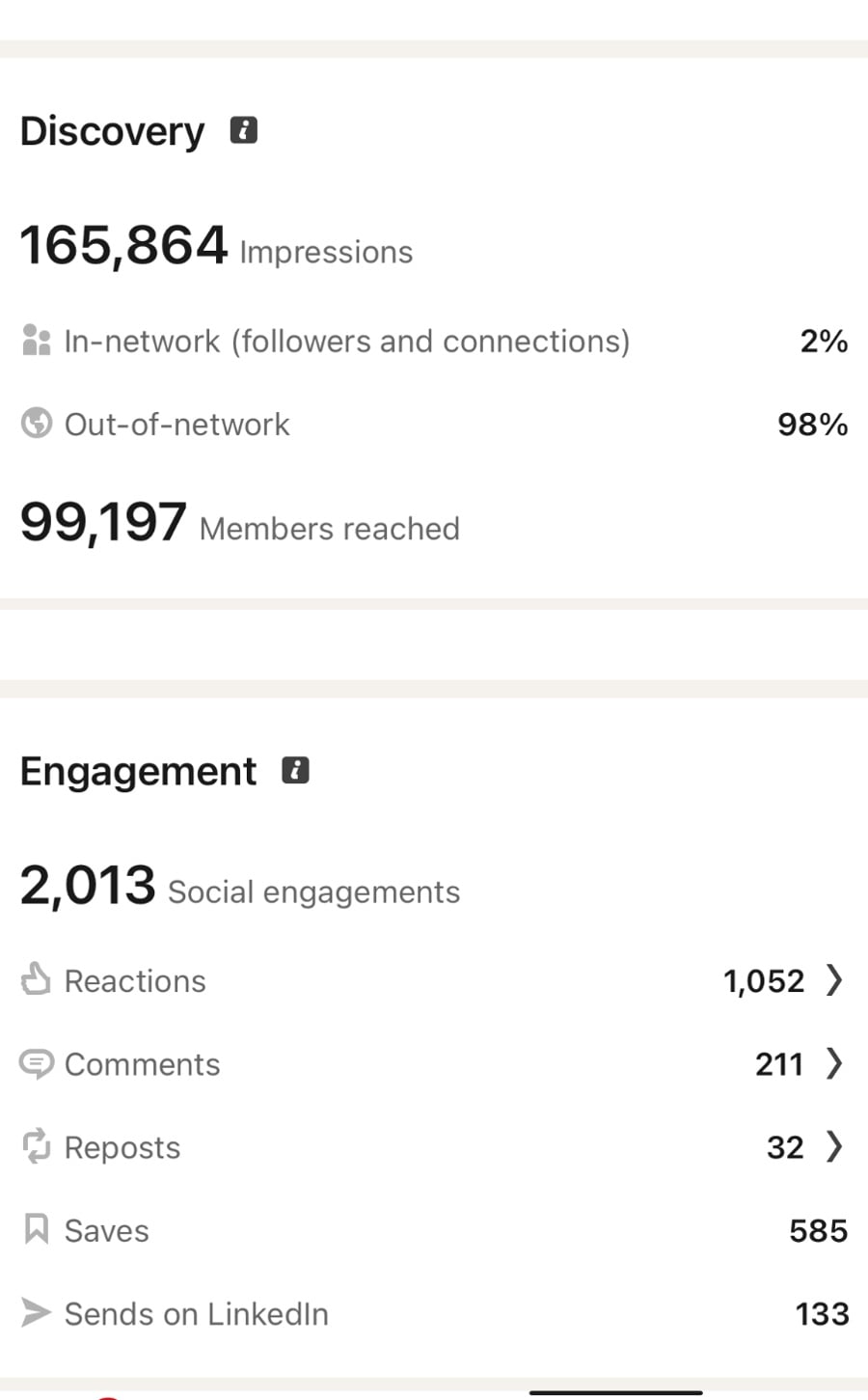
After sharing the early Instagram experiment on LinkedIn, the post generated 165,864 impressions and reached 99,197 members. Notably, 98% of the reach was out-of-network. It produced 2,013 social engagements, including 211 comments, 585 saves, 133 sends, and 32 reposts.
Instead of treating those comments as launch-day engagement, we treated them as customer research. People challenged the workflow: brand voice, control, quality, ROI, agent coordination, platform safety, and whether the result could generalize.
Who was in the conversation?
The discussion included marketers and agency professionals, founders and small-business owners, creators and social media operators, AI and agent-system builders, e-commerce professionals and consultants, and potential users exploring the product.
We are not assigning percentages to those groups because the comments were conversational and often touched multiple themes. The value here is qualitative: similar concerns appeared from different professional angles.
Concern 1: Can AI maintain brand voice?
AI can help maintain brand voice, but a one-time prompt is not enough. Consistency requires persistent context, examples, explicit boundaries, and feedback about what feels right or wrong.
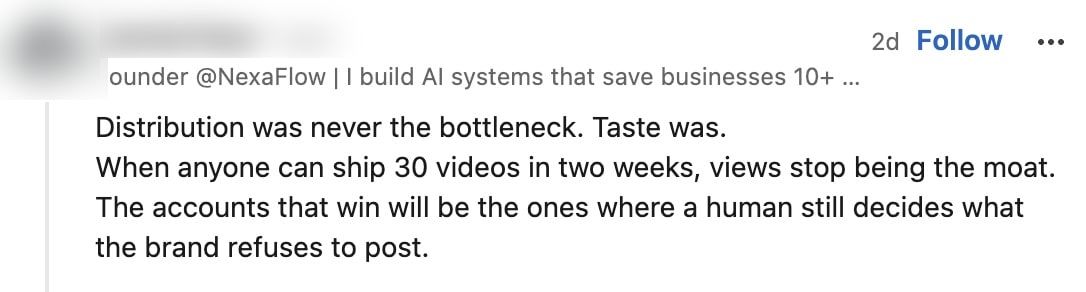
One commenter put the issue sharply: "Distribution was never the bottleneck. Taste was." The comment argued that when content becomes cheap, a human still needs to decide what the brand refuses to post.
We think that is an important distinction. Brand voice is accumulated judgment: what the brand believes, how promotional is too promotional, which jokes fit, and which trends are not worth chasing. Humans define the taste; AI learns to execute within those boundaries.
Concern 2: Where should humans stay in the loop?
Humans should remain responsible for direction and judgment without having to manually drive every step of execution.
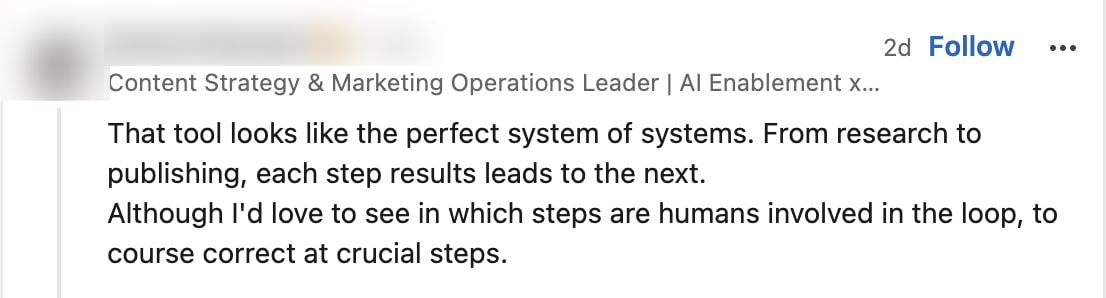
A content strategy and marketing operations leader asked where humans should be involved "to course correct at crucial steps." That captures the useful middle ground: not human approval of every comma, and not a black box publishing indefinitely.
Our working principle is: Humans stay in the loop, but they do not have to drive the loop.
Concern 3: Do multiple agents actually help?
Multi-agent architecture matters only if the agents share context, hand work off cleanly, and improve the same workflow.
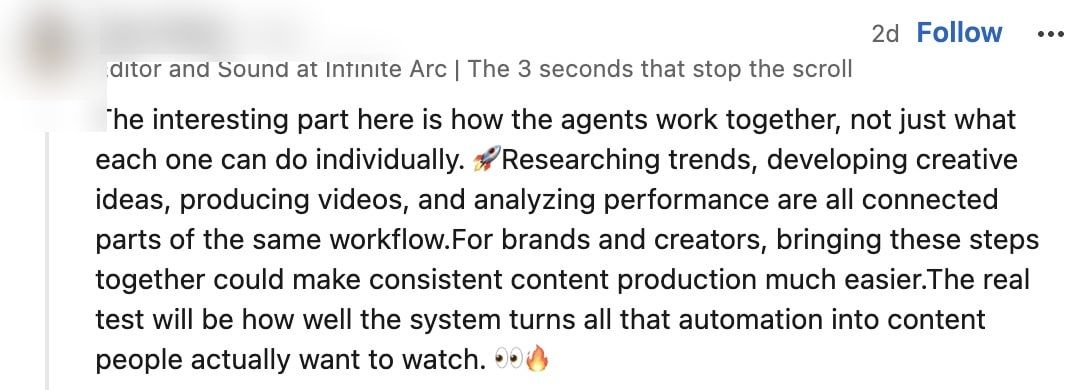
One creator and operator noted that the interesting part was "how the agents work together, not just what each one can do individually", and added that the real test is whether all that automation produces content people actually want to watch.
That is the right test. Specialization without coordination simply creates more tools for the human to manage. The point is for research, strategy, creation, listening, and coordination to become connected steps in one learning loop.
Concern 4: Does AI just produce more mediocre content?
More content is not the goal. More learning per unit of time is.
Cheap production can flood feeds with mediocre output if the strategy is simply to generate more. Our preferred use is different: research first to narrow the space, test more plausible hypotheses, observe audience response, and adapt quickly.
The operating principle is not post more. It is research → test → learn → adapt faster.
Concern 5: Views are nice. What about revenue?
Views are an attention signal, not the final business outcome.
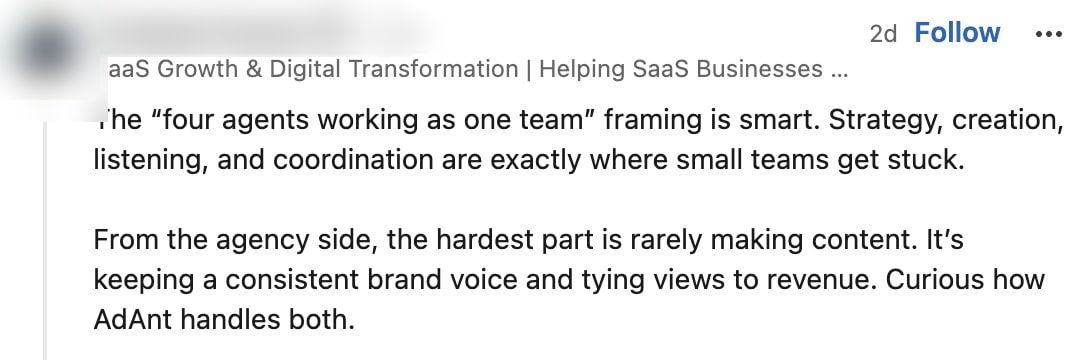
An agency-side commenter summarized the challenge well: the hard part is "keeping a consistent brand voice and tying views to revenue." Our Instagram experiment demonstrated attention and audience growth, but it did not prove that 49.9M views equals revenue.
The business funnel is closer to Views → Engagement → Followers → Traffic → Leads → Conversions → Revenue. A mature AI marketing system should increasingly learn from the downstream outcomes the business actually values.
Concern 6: Will AI replace creators, agencies, or social media managers?
The near-term shift is less about replacing every marketer and more about automating the manual system around marketing work.
AI can research formats, generate variations, test ideas cheaply, coordinate briefs, schedule work, and analyze results. Human creators and agencies can spend more of their time on positioning, taste, relationships, strategy, and high-value production.
A small team may therefore gain leverage that previously required a much larger operation. That is already a meaningful change without declaring every human role obsolete.
Concern 7: Can I trust it with my account?
Trust depends on visibility, permissions, review controls, and platform-compliant integrations, not on claiming that the AI is infallible.
Users should be able to see what agents are doing, give feedback, control what is scheduled, and retain authority over sensitive actions. Platform differences matter too: Instagram, TikTok, YouTube, X, and paid advertising do not have identical audiences, algorithms, formats, or integration models.
What did the 211 comments change for us?
The conversation reinforced a broader shift. The generation problem is becoming easier. The coordination, learning, trust, and judgment problems are becoming more important.
People were not primarily asking Can AI make a video? They were asking: Can I control it? Can it understand my brand? Can it learn from what happens? Can multiple agents coordinate? Can it optimize for outcomes that matter to my business?
Our refined thesis is simple: the next generation of AI marketing tools will not win because they generate more content. They will win because they learn continuously while keeping humans in control. For how such a system works in practice, see Can AI agents actually run your social media?