
How We Got 49.9M Instagram Views in One Month
We used AI to run a fast learning loop on a brand-new Instagram account: research what is working, create quickly, publish, read the audience's response, and adapt. In 30 days it reached 49.9M views and 10.5K followers. The lesson is that AI makes testing cheap. It does not guarantee virality, transfer to other platforms, or revenue.

A case study in AI-assisted social media experimentation: what we did, what the numbers mean, and what one fast-growing account cannot prove.
What was the experiment?
We started with a simple question: could someone with almost no content-creation experience use AI to systematically discover social content that people wanted to watch?
The Instagram account was brand new, with no existing audience and no paid distribution. Before this, I had never made a video and had barely posted on social media. We used AdAnt as part of the workflow, but the hypothesis was not that AI could press a button and manufacture virality. It was that AI could reduce the cost and time of the learning loop: research, create, publish, observe, and adapt.
What were the results?
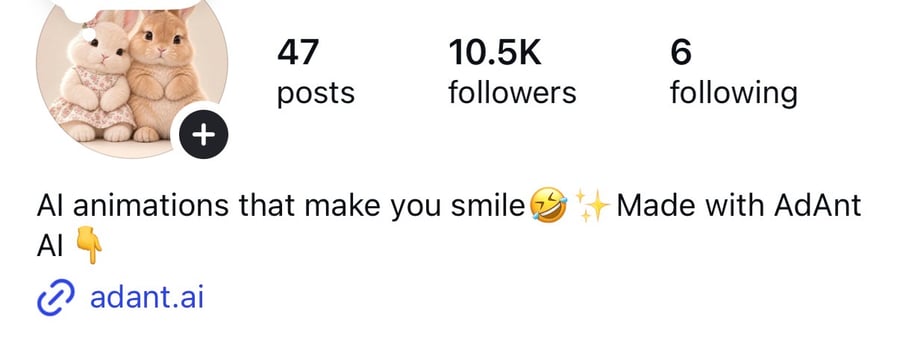
In the first two weeks, we published 30 posts. They generated 7.8M organic views and grew the account to 6,000+ followers. We kept the experiment running. At the end of one month, we had posted 47 posts, with 49.9M views and 10.5K followers.
Was it just one viral video?
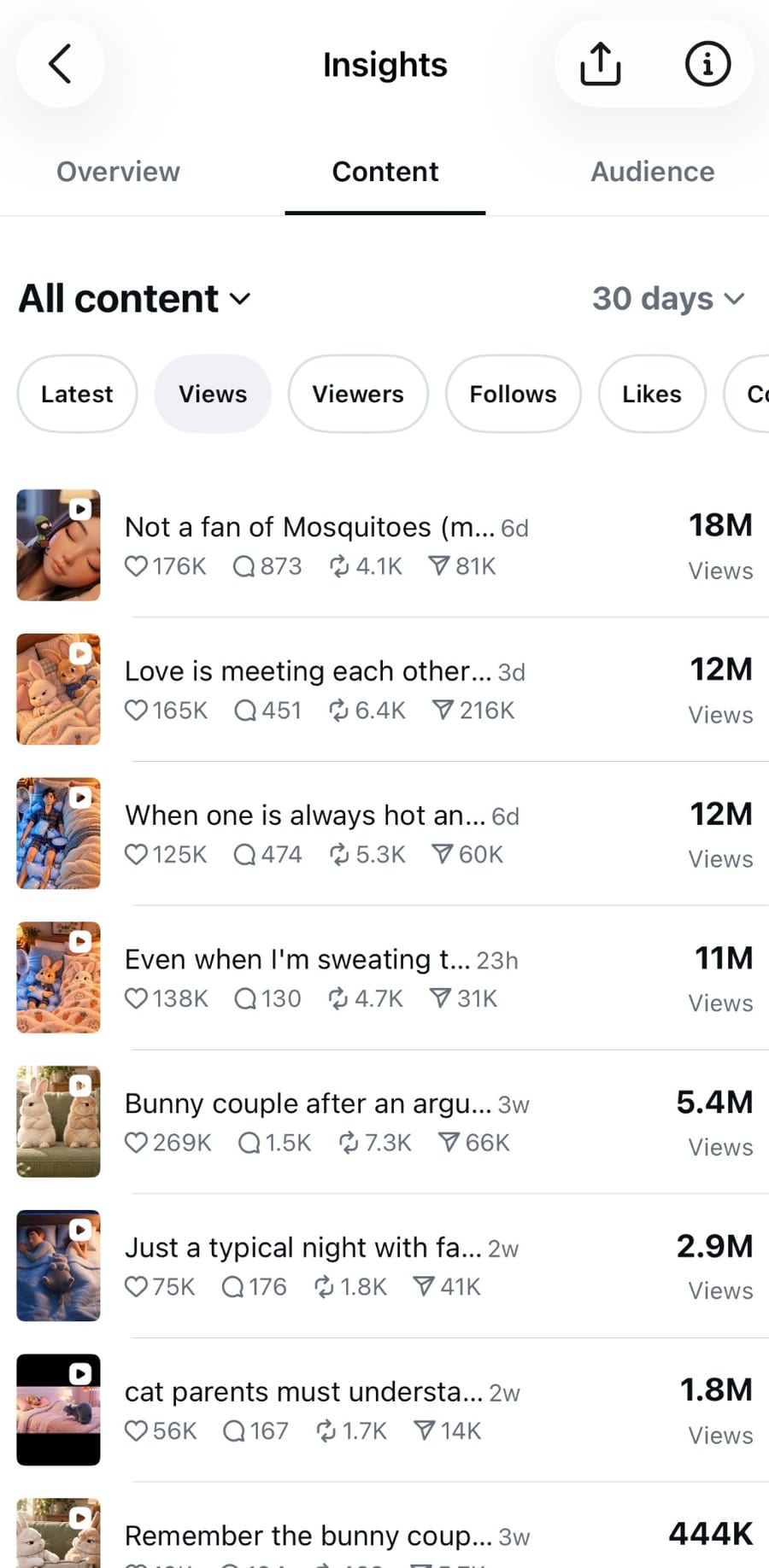
One viral video proves very little. What made the experiment more interesting was the distribution of results. In the 30-day Insights view, the leading videos showed approximately 18M, 12M, 12M, 11M, 5.4M, 2.9M, and 1.8M views.
That does not establish a universal formula for virality. It does show that the aggregate result was not driven by a single outlier. The more useful question became repeatability: can the workflow keep discovering promising formats, discard weak ones, and adapt as the platform changes?
What did we actually do?
The workflow was straightforward: Research → Create → Test → Learn → Repeat.
We began with research rather than random generation: what was trending, which video structures were spreading, how successful posts opened, and which formats seemed adaptable to the account. The goal was not to copy individual posts but to start with better hypotheses.
Once published, the audience supplied the next signal. Which concepts attracted attention? Which generated shares or comments? Which attracted followers rather than only views? The next batch incorporated those observations.
How does cheap creation change the economics of being wrong?
One of the biggest changes AI brings to social content is not that every generated video is better. It is that the cost of being wrong can become much lower.
A traditional video can accumulate substantial sunk cost before the audience sees it. In our workflow, a short video could often be created in minutes. If a format was not showing promise, moving on was relatively cheap.
AI does not remove uncertainty. It makes uncertainty cheaper to explore.
Is it quality or quantity?
Publishing 47 posts can sound like a quantity strategy, but quantity and quality are not clean opposites. Before publishing, teams can judge craft and brand fit; they cannot know with certainty how the audience will respond.
More informed experiments create more signals. Research makes those experiments less random. Audience response helps reveal what quality means for this audience, and the team can then double down on patterns that repeatedly work.
Why are views not the same as audience?
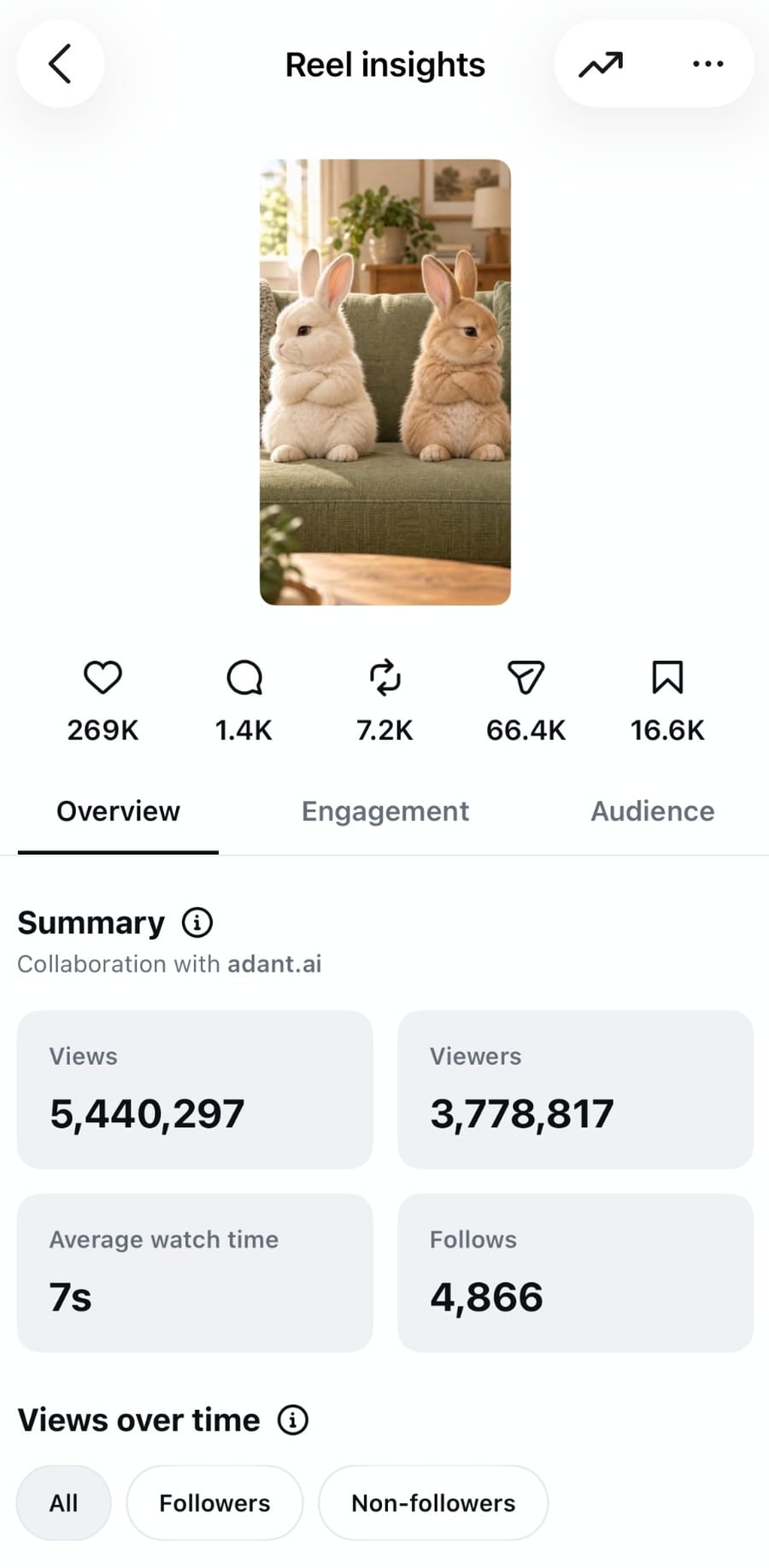
One bunny Reel makes the distinction concrete. Its Reel Insights showed 5,440,297 views, 3,778,817 viewers, and 4,866 follows.
The highest-viewed video was not necessarily the strongest follower converter. That reinforced an important lesson: reach and audience growth are related, but they are not the same objective. The same principle extends further down the funnel to traffic, leads, conversions, and revenue. We look at that gap in why Reels get views but no followers.
What can we conclude, and what can't we?
The experiment supports a few practical conclusions: AI can lower the cost of creating and testing social content; research can make experiments less blind; a small team can run more informed tests; and audience signals can feed back into the next round quickly.
It does not mean every account will get 49.9M views, every AI-generated video performs, one month predicts long-term growth, Instagram success automatically transfers to TikTok, or views automatically translate into revenue. Those limitations define the next questions worth solving.
What happened next?
We shared the early two-week results on LinkedIn. The post generated 165,864 impressions and 2,013 social engagements, including 211 comments. Marketers, founders, creators, agency operators, AI builders, and potential users began challenging the idea from their own perspectives.
We treated those comments as customer research. The third article in this series examines what people actually cared about once the conversation moved beyond the headline growth number, and the first covers how an AI social media marketing system works.