
About this skill
Tens of thousands of particles drift out of a cloud, settle into a form, breathe while the reader reads, scatter when the pointer passes and re-form, then turn into the next form as the page scrolls. The skill brings a three.js engine that runs the whole simulation on the GPU, with shapes sampled from parametric surfaces, lines, meshes, SVG paths or text, and nine ready-made kinds: a constellation, an anemone, an hourglass with falling sand, a double helix, an ambient field, a falling drift, a leaf drawing itself in, a jellyfish released from an egg, and ribbons of light. The agent starts from a brief that pins down each form's parts, colours and motion, builds the page with still frames for browsers without WebGL, and checks it in Chrome. The check reads the simulation back to time how long the form takes to settle and how close every particle ends up, and records frame times for each particle count.
You say
Using this skill, ask me the brief's questions for my observatory's site, then build a hero where particles settle into our telescope dome, become a star map as I scroll and end as the word 'Tonight'. Run the form check and show me the desktop, phone and no-WebGL screenshots.
How it works
- Your agent asks the brief's questions: the fact behind the page, each form's parts and colours, what each is made from, how it draws in and moves at rest, and the copy.
- It builds the static page with a still frame per section first, then the shapes, then the particle form and the scroll and pointer wiring.
- It renders the stills from the engine itself, so the page without WebGL shows the same forms.
- It runs the form check in Chrome, reads the settle times, errors and tier table, fixes what failed, and records a preview clip.
Getting a good result
- Name the brightest part of each form. Additive points burn dense parts to white, so light is a decision, not an accident.
- Give each form one motion at rest: a slow turn, a sway or a flow. Three motions at once read as noise.
- Start from the kind closest to your idea in the kinds table, then change the parts. The mechanics are already tuned.
What you get
- A three.js engine: GPU particles that settle into any shape, morph between shapes, breathe and part around the pointer
- Nine ready-made kinds, from a turning double helix to a jellyfish that bursts out of an egg, and the brief values for each
- A working example site: a pine seed, a seedling, a tree and the storage temperature, one per section
- A brief format with a field for every choice the model would otherwise guess
- A Playwright check for settle time, distance to the shape, the pointer, frame time per particle count, pixel ratio, reduced motion and the no-WebGL still, plus a still renderer and a clip recorder
Good fit
- Launch pages and studio sites with one strong subject that can be drawn as a shape
- Agents that write front-end code and can run Node and a browser
- Teams that want the motion measured, down to how close each particle lands
Not for
- Pages where the subject is a photograph or a product shot, which particles only blur
- Bursts, sparks and trails, which an effects library does better
- Sites that must run on GPUs without WebGL 2; those visitors see the still frames
How to install it
- Download the ZIP and unzip it.
- Move the folder holding
SKILL.mdinto your agent's skills folder, such as~/.claude/skills/for Claude Code. - Start a new session and ask for what you want to make.
Needs: An agent that reads skills, Node 20 or later and Playwright with Chrome, for the check, the stills and the recorder, ffmpeg, only to record the preview clip.
Popular on X
Posts showing demand for this kind of video. Unless a post names this tool, it wasn't made with it.
- A post listing five UI and UX sites for builders, this library among them 98,508 views on X, measured 8 November 2026
FAQ
What does it cost?
$2.99 once for this skill, or $99 once for every skill in the library. It also comes with every paid AdAnt plan, from $15 a month. It runs on your own computer and uses no AdAnt credits.
Can I use it in commercial work?
Yes. The skill's code is MIT licensed: use it and what it makes in your own commercial work, including for clients, and keep the license file with any copy you pass on.
How many particles can it run?
The engine has four tiers: 65,536, 36,864, 16,384 and 8,192 particles. It starts phones at 16,384, drops one tier when the 90th-percentile frame time goes over 20 ms, and never climbs back, so it cannot flicker between tiers. In headless Chrome on an Apple M-series laptop shared with other work, the example held 65,536 particles at a 95th-percentile frame time of 18.2 ms; on the same laptop on battery under heavy load, every tier, even 8,192 particles, measured about 34 ms. Headless frame times follow the machine more than the particle count, so the skill says to read the tier table and run the check on your slowest machine.
How do you know the shape is right?
The check reads the particle positions and their targets back from the GPU. On the example, the seed settled about 2.9 seconds after load and its particles ended a mean 0.11% of the form's radius from their places; the seedling, tree and temperature settled 2.2 to 2.8 seconds after scrolling to them, within 0.35%. A pointer sweep moved the form and it re-formed within a quarter of a second. The check also fails if a section shows the wrong shape.
What happens without WebGL or with reduced motion?
Each section has a still frame of its form, rendered by the same engine, which shows without WebGL or JavaScript. With reduced motion the engine draws each form already settled, once, and redraws only when you scroll to another section. The check fails if the form is not settled or the canvas keeps drawing while idle.
Does it work with React or Next.js?
Yes. The engine is plain modules on three.js. The notes cover creating it in an effect and disposing it on unmount, loading it as a client-only component in the App Router with the stills rendered on the server, and driving it from a scroll listener rather than React state.
Is this the site that inspired it?
No. The idea comes from a library of scroll-driven website prompts, linked on this page, whose prompts are only for its members. AdAnt wrote this skill, its engine, scripts and example site without them, and the library's makers did not write or review it. The clip on this page is AdAnt's example site, recorded with this skill's script.
Can I use what it makes commercially?
Yes. The pages you build are yours. The engine, scripts and example are MIT, and the license text is in the ZIP. three.js is MIT too.
Related skills
Parallax Plates Site
Have your agent split one picture into depth plates and build a page that flies through them on scroll, then prove in Chrome that no plate edge ever shows.
Dither & Glyph Hero
Have your agent build a hero that draws a live 3D scene in two inks, as dither, scanlines or glyphs, around an AI prompt, then check it in Chrome.
Scroll-Driven Site
Have your agent build a landing page where scrolling pins, scrubs and reveals each scene, then measure it in a real browser.

Cinematic Video Hero
Have your agent build a one-screen hero from footage and type, with a freeze frame, text behind the subject and a loop, then measure it in a real browser.
Shader Reveal Site
Have your agent build a page where the pointer or the scroll uncovers a second picture through a shader, then measure the trail, the GPU and every fallback in Chrome.
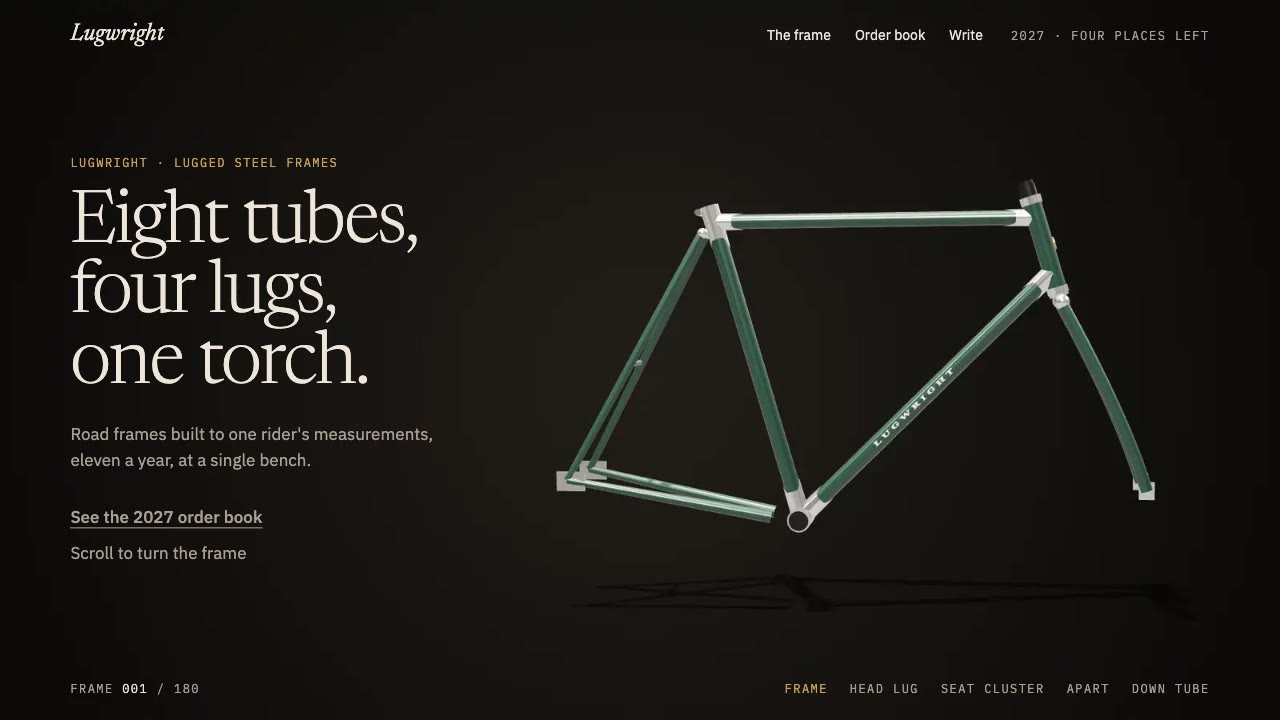
Scroll-Scrubbed Film Site
Have your agent build a landing page where scrolling plays a film frame by frame, with chapters, callouts and a preloader, then check it in Chrome.

Scroll-Posed 3D Product
Have your agent build a page where one 3D product holds the centre while the scroll poses it, section by section, until it docks into the buy box.

Cursor Playground Hero
Have your agent build a hero section visitors play with, on small simulations that behave the same on every screen and never blow up.

Footage Landing Page
Have your agent build a full landing page under a looping footage hero, every word in one content file, then check it in Chrome.
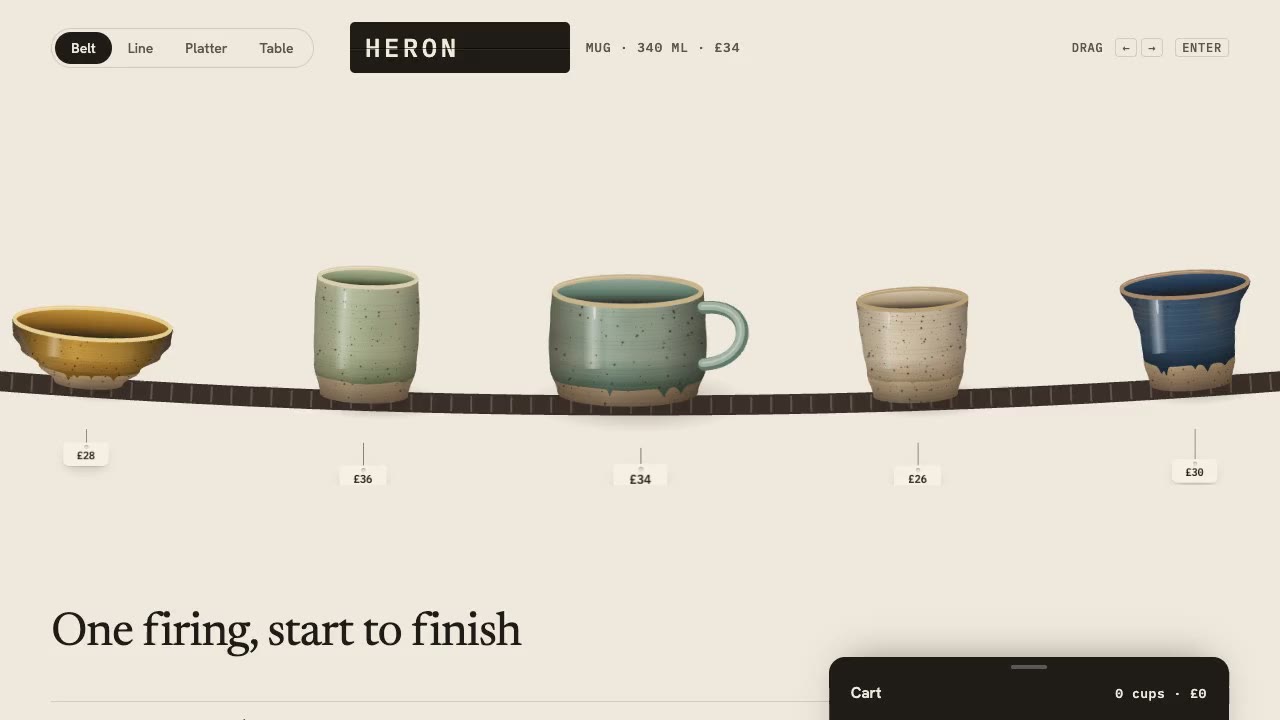
Drag Gallery Storefront
Have your agent build a shop you browse by dragging, with inertia, a seamless loop, a product sheet and a cart, then check it in Chrome.
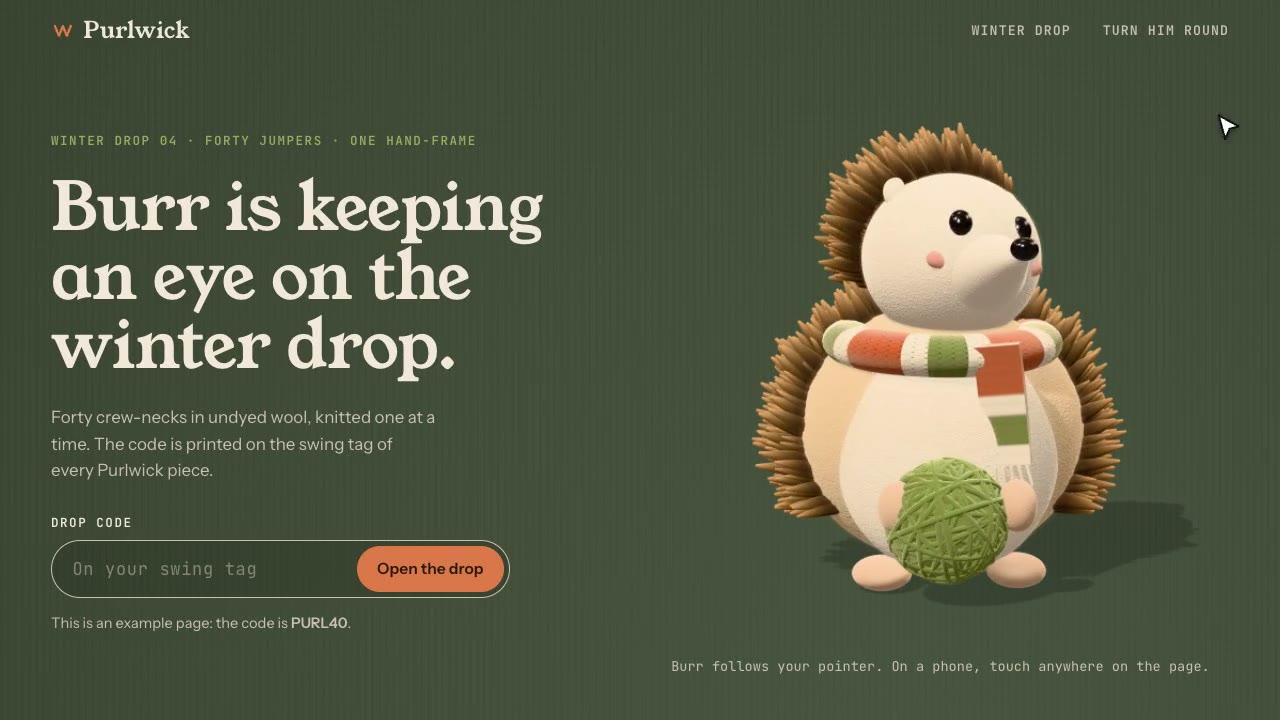
Cursor-Gaze Character
Have your agent build a landing page whose character turns its head to follow the pointer, from frames it renders once, then measure it in Chrome.
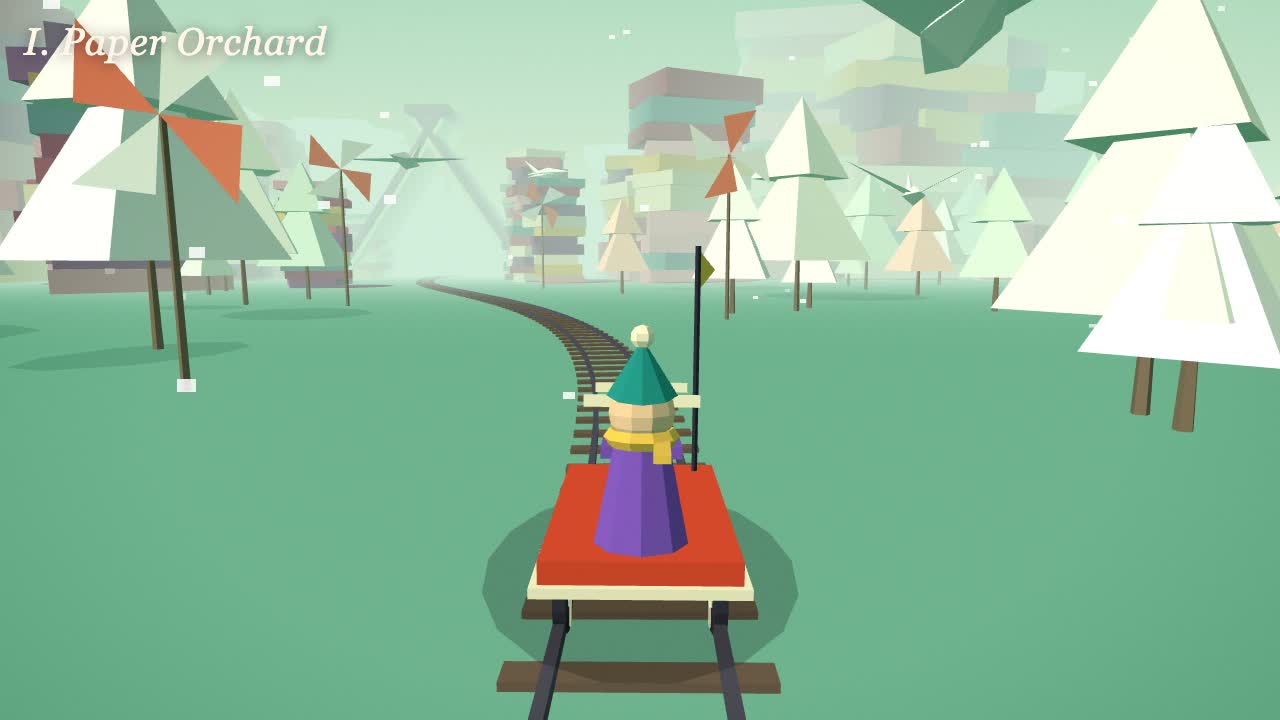
Dreamlike Voyage Browser Game
Have your agent build a calm ride through several invented worlds in three.js that plays in a browser tab and on a phone, check it, and record a clip of it.